Energy Storage in Michigan.

DTE customers average more than triple the national outage time. Ice storms, derechos, and lake-effect snow knock the lights out for days. Michigan also just mandated 2,500 MW of utility-scale storage by 2030, and DTE/Consumers are rolling out new residential demand-response programs to match. A home battery is infrastructure here, not luxury.

Get my report See the rate-hedge math
450+ min/yr
DTE outage time per customer
600K+
DTE customers, Aug 2023 storm
3-7 PM M-F
DTE Time-of-Day peak
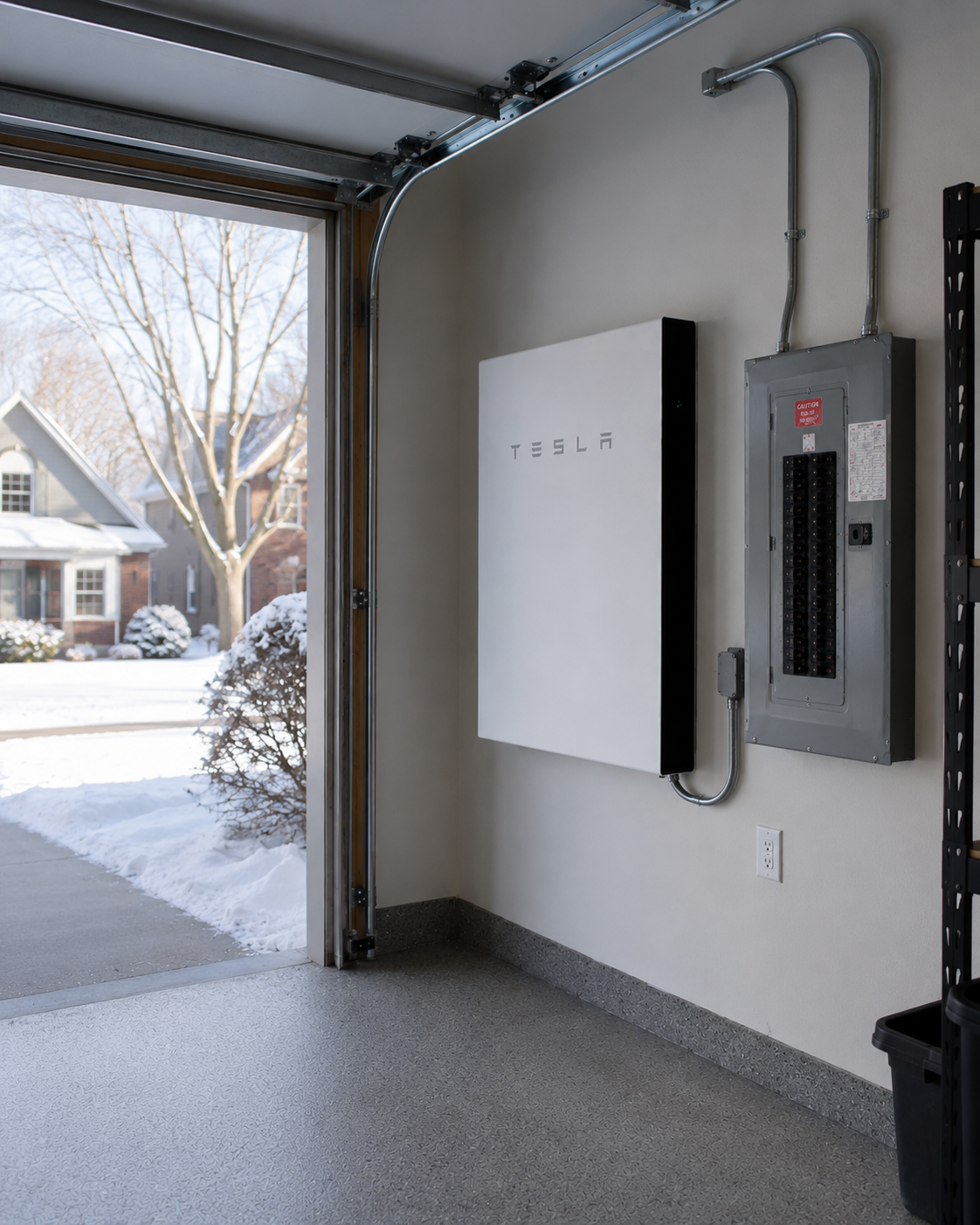
A wall-mounted residential battery storage system installed at a Michigan home, clean utility install with conduit visible
Why now · Michigan

Electric bills have climbed every year.

Michigan residential electricity climbed from roughly 12.7¢/kWh in 2010 to ~21¢/kWh today, averaging about 3.4% per year, the fastest climb in the Great Lakes. The MPSC approved a $242M DTE rate hike in early 2026 and another adjustment is in the queue. The case for storage here is resilience-first, with arbitrage and grid-services value layered on top.

The hedge Storm resilience + ToD arbitrage
Get my report
Michigan residential electric rate
2010–2025 · cents per kWh, all-in
$0 low mid high 2010 2015 2020 2025 US avg $0.169/kWh MI all-in $0.210/kWh $0.127/kWh Your stored kWh (ToD + resilience) value of every shifted kWh ¢/kWh, residential all-in
MI residential rate Your stored kWh US national average
Source · EIA Form 861, residential class, 2010–2025. State averages and the US national line both pulled from the same dataset for an apples-to-apples comparison.
Major utilities coveredDTE Energy, Consumers Energy, Indiana Michigan Power, Upper Peninsula Power, Great Lakes Energy Co-op
A real example · Michigan

What a 13.5 kWh Powerwall does in a Michigan home.

Take a DTE customer in Oakland County who adds a Powerwall 3 alongside their existing solar array. Two value streams: ongoing DTE Time-of-Day arbitrage on the 3-7 PM weekday peak, and resilience against the 450+ outage minutes that the average DTE home logs every year. Solar self-consumption is a quiet third.

See the pieces of the stack
01 · Why It Works Here

Michigan batteries earn through reliability first.

DTE and Consumers Energy are catching up on grid hardening (the 2023 storm forced a regulatory reckoning) but Michigan still sits in the bottom tier of U.S. reliability. The MPSC approved a 2,500 MW utility-scale storage mandate in March 2026, and the residential demand-response pilots that will follow are next on the rulemaking docket.

450+ min/yr
DTE residential outage time
More than triple the national average; lake-effect storms and aging distribution take the blame
600K+
Aug 2023 DTE outage
Single thunderstorm sequence, multi-day restoration in some metro Detroit suburbs
13.5 kWh
Powerwall 3 usable capacity
Runs a gas-furnace blower + well/sump pump + fridge + lights for 24-36 hrs of winter draw
2,500 MW
MPSC storage mandate (utility-scale, by 2030)
Sets the stage for the residential demand-response programs DTE and Consumers will file next
Get my report
02 · The Components

Every value line, spelled out.

Michigan doesn't run a state residential battery rebate (yet, the MPSC mandate sets the stage). The value flows through three working channels: DTE/Consumers Time-of-Day arbitrage, ongoing resilience against high-frequency outages, and solar self-consumption against retail rates. Each line stands on its own. Stacked, they make the project pencil even without a state grant.

  • DTE Time-of-Day arbitrage (3-7 PM peak weekday discharge)~$300-400/yr
  • Consumers Energy Smart Hours (similar TOU spread)~$250-350/yr
  • Resilience value (avoided generator, spoilage, hotel nights)$500-2,000/yr
  • Solar self-consumption boost (~2,000 kWh shifted at $0.21)~$420/yr
  • Great Lakes Energy co-op Energy Wise battery incentiveco-op members only
  • Lease/PPA financing available, ITC passed through in paymentsno money down
  • Equipment lifespan and warranty10 yrs · 70% capacity
Get my report
03 · Install Timeline

From first call to backup-ready.

A typical Michigan battery install runs 7–11 weeks from first call to Permission to Operate. DTE and Consumers Energy interconnection paperwork is the main timing variable.

01.
Site survey & load study
In-home electrical assessment, panel inspection (older MI homes often need a service upgrade), NEC 705.12 calculation, gas-furnace blower load profiling. Designs the critical-loads backup panel.
Weeks 1-2
02.
Permits + DTE/Consumers Energy interconnection
Township building/electrical permit, utility interconnection application. Time-of-Day rate enrollment paperwork in parallel if not already on the tariff. Most MI townships issue battery permits within 3-5 weeks.
Weeks 3-6
03.
Equipment procurement
Powerwall 3 (or Enphase IQ Battery, FranklinWH) ordered. Lead time 2-6 weeks depending on installer supply allocation. Often overlaps with permit work.
Weeks 4-8
04.
Installation & commissioning
Install is typically 1-2 days on-site. Backup test confirms real runtime on your specific loads (furnace blower included). Utility witness/PTO follows in 2-4 weeks.
Weeks 7-10
05.
Battery live, standing by
Smart inverter automates ToD arbitrage on the 3-7 PM peak window. Battery stands by for any outage and seamlessly takes over the loads panel. App notifies you of dispatch events and outages while away.
Post-install
Get my report
04 · Honest FAQ

The real questions Michigan homeowners ask.

Actual questions that come up in the first installer conversation, answered for a typical MI homeowner in 2026.

How often is DTE actually out, not the marketing number?

The honest figure: DTE residential customers have averaged 450+ minutes of outage time per year, with major events pushing some neighborhoods past a week without power. DTE reported a 60% reduction in outage minutes for 2025 vs. 2024, which is real progress, but Michigan is still firmly in the bottom tier nationally for grid reliability. A battery insulates your home from that variance regardless of which direction the trend goes.

Will a battery actually keep me running through an ice storm?

Yes, with realistic load planning. A 13.5 kWh battery can cover the essential circuits, furnace blower (gas heat still needs electricity to run), fridge, well pump, sump pump, lights, and Wi-Fi, for 24-36 hours of typical winter draw. A second battery doubles that. Solar charging during the day extends it indefinitely as long as there's sun, even a snowy overcast day produces meaningful kWh in February.

What about lake-effect storms that knock lines down for days?

That's where solar+storage starts beating a standby generator. A generator runs out of fuel; deliveries stop when roads are closed. A solar-charged battery refills daily as long as there's any sun overhead. For rural west-Michigan and Up North homes, this is the resilience pattern that actually works through a multi-day event.

My house has a natural gas furnace, does a battery still make sense?

Absolutely, and gas-heated homes are some of the easier sizing problems. Your furnace needs only its blower motor and ignition powered, which together draw ~500-800 watts. A 13.5 kWh battery dedicated to furnace + fridge + lights + sump pump easily lasts 24+ hours. You're not trying to run a heat pump on it.

Does DTE Time-of-Day arbitrage actually pay anything?

It pays meaningful dollars but not enough to justify storage on its own. DTE's ToD spread is narrower than ConEd's, annual arbitrage value typically lands $300-400 for a 13.5 kWh system. Consumers Energy Smart Hours runs similar. Layered on top of resilience and solar self-consumption, it shifts the project from "expensive insurance" to a system with a real long-term return.

When will Michigan have a residential battery rebate?

The MPSC approved a 2,500 MW utility-scale storage mandate in March 2026, which is the precursor to the residential demand-response programs DTE and Consumers will need to file. Most state programs follow this sequence (utility-scale procurement first, distributed/residential incentives second). Realistic timeline: 2027-2028 for a formal MI residential battery rebate. Until then, the value flows through arbitrage and resilience, which already make the math work in DTE territory.

Explore more

Other states and programs.

Looking for the same kind of program in another state, or a different program in yours? Tap any pill to jump.

See how storage fits your specific Michigan home.

Your Home Efficiency Score sizes the right battery for your panel and bill, plans the loads worth backing up for the next ice storm, runs the DTE/Consumers ToD arbitrage math, and shows your real backup hours based on your address and utility.

Get my report