
Solar in Michigan.

Upfront rebate plus 20-year production payments.
$2.40/W
Upfront rebate
$0.11/kWh
Production payment
20 years
Contract term
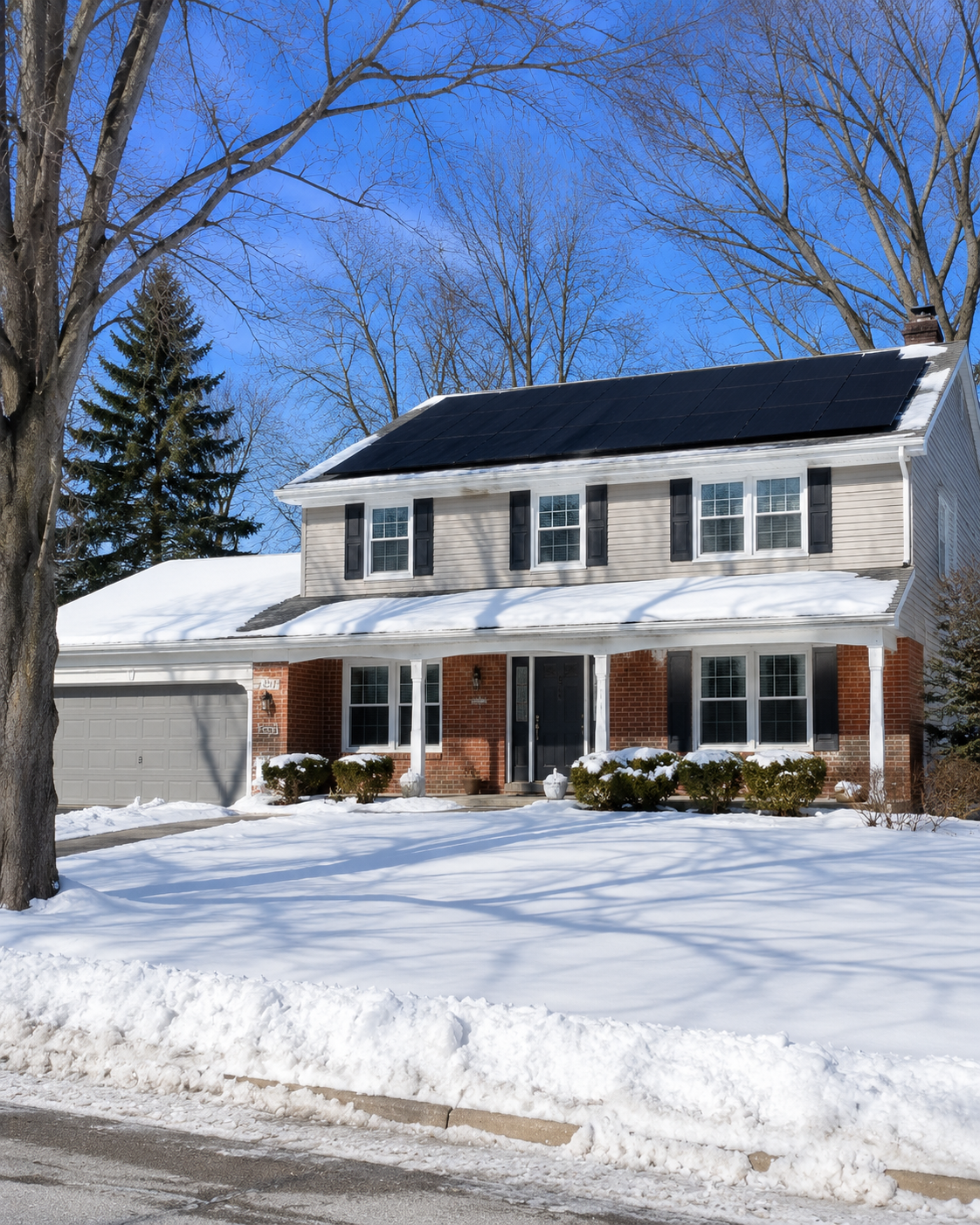
A Michigan solar project funded through DTE Solar Currents
Why now · Michigan

Your rate climbed 40% in 15 years.

Michigan's residential electric rate climbed from 14¢/kWh in 2010 to 19.5¢/kWh by 2025 on DTE territory. DTE Solar Currents pays a buyback rate for excess production.

The hedge Solar locked at 8¢/kWh, flat 25 yrs
Get my report
Residential rate · Michigan
2010–2025 · cents per kWh
10¢ 20¢ 30¢ 2010 2015 2020 2025 US avg $0.169/kWh DTE 19.5¢ Consumers 18.0¢ Solar 8.5¢ your rate hedge ¢/kWh, residential
DTE EnergyConsumers Energy Solar LCOE US national average
Source · EIA Form 861, residential class, 2010–2025. State averages and the US national line both pulled from the same dataset for an apples-to-apples comparison.
Major utilities coveredDTE Energy, Consumers Energy, Indiana Michigan Power, Upper Peninsula Power, Great Lakes Energy Co-op
A real example · Detroit, MI

What an 8 kW Solar Currents install actually pays back.

An 8 kW rooftop array on a Detroit home generates ~10,400 kWh/yr. DTE Solar Currents pays ~$0.084/kWh for excess production sent to the grid, layered with onsite consumption offset at retail. The economics work best for high-daytime-usage homes.

See the pieces of the stack
01 · Why It Works Here

DTE Solar Currents: buyback at fixed rate.

DTE pays a flat-rate buyback for excess production, layered with onsite consumption offset at full retail.

$0.084/kWh
DTE export buyback
Locked-rate buy-all for excess production
19.5¢/kWh
DTE retail today
~22% above the U.S. average
10,400 kWh
Typical 8 kW production
Matches average MI home use
30 yr
Panel warranty
Standard residential coverage
Get my report
02 · Rebates & Benefits

Every rebate line, spelled out.

Current 2026 rebate amounts for DTE Solar Currents. Verify against the program operator at signing.

  • Upfront rebate$2.40/W
  • Production payment$0.11/kWh
  • Contract term20 years
  • Distributed Generation ProgramNet metering (DTE: $0.0775-$0.14/kWh)
Get my report
04 · Install Timeline

From first call to permission to operate.

A typical Michigan residential solar install runs 9–13 weeks from site survey to grid interconnection. Permitting and inspection sit on most of that runway.

01.
Site survey & system design
Contractor evaluates roof orientation, shade, structural load, and produces a system design with an annual production estimate.
Week 1
02.
Permitting & utility interconnection app
Building permits filed with the town; interconnection application filed with the local utility. Review typically runs 6–8 weeks.
Weeks 2-5
03.
Equipment procurement
Panels, inverter, racking, and balance-of-system components ordered after permit approval. Lead times depend on configuration.
Weeks 5-8
04.
Installation
Most residential installs complete in 1–3 days on-site. Building permit inspection follows a few days later.
Weeks 8-10
05.
Permission to operate (PTO)
Final utility inspection and net-metering activation. PTO is when the system legally begins exporting and earning credits.
Weeks 10-13
Get my report
06 · Questions Homeowners Ask

The honest FAQ.

Actual questions that come up in the first installer conversation.

Is the program currently open?

Periodically paused and reopened. Always verify status with DTE.

Can I sell my home with this contract attached?

Yes, the Solar Currents contract typically transfers to the new owner.

What about Consumers Energy customers?

Consumers has its own DG program but no equivalent of Solar Currents.

Get my report
Explore more

Other states and programs.

Looking for the same kind of program in another state, or a different program in yours? Tap any pill to jump.

Ready to see how DTE Solar Currents applies to your home?

Your Home Efficiency Score shows your exact rebate stack, across this program and every other one you qualify for in 2026.

Get my report