Energy Storage in Florida.

Hurricane Milton put 2+ million FPL customers in the dark for five days, in October heat. Helene took out another 680,000 the week before. In Florida, a home battery isn't a finance product, it's the part of your house that keeps the AC running when the grid is on the ground. Florida also exempts solar+storage equipment from property tax and sales tax, two of the cleanest state-level supports in the country.

Get my report See the rate-hedge math
2M+ homes
Lost power, Hurricane Milton
0%
State sales tax on solar+storage
115%
FPL net-metering offset cap
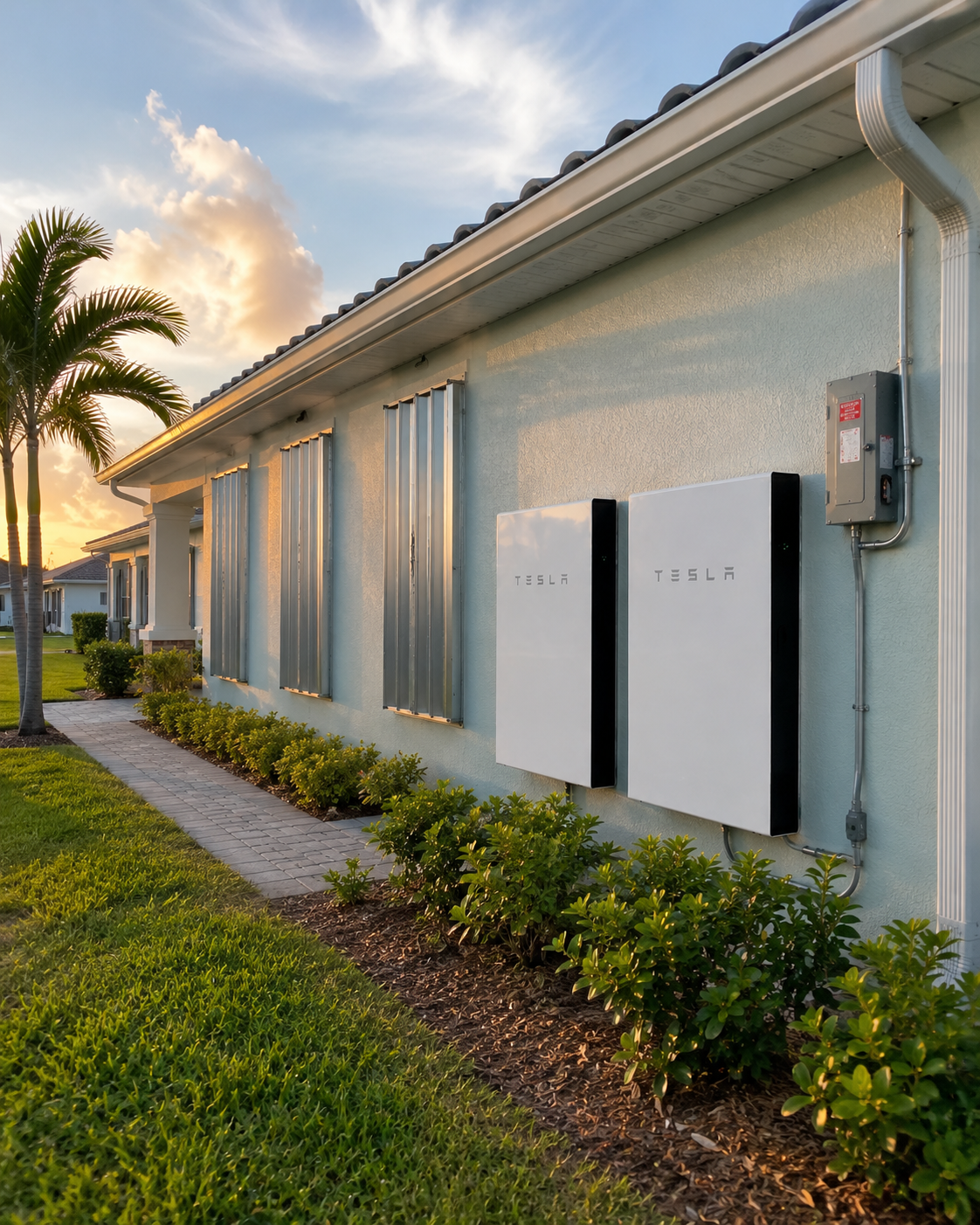
Wall-mounted residential battery storage installed at a Florida home, clean utility install with conduit visible
Why now · Florida

Electric bills have climbed every year.

Florida residential electricity climbed from roughly 11.5¢/kWh in 2010 to ~16.5¢/kWh today, averaging about 2.4% per year. The Florida PSC approved a multi-year FPL rate settlement in late 2025 that pushed supply charges higher through 2027. Combined with hurricane season exposure, the case for storage in Florida is resilience-first, with solar self-consumption layered on a sub-retail export structure.

The hedge Hurricane resilience + tax-exempt install
Get my report
Florida residential electric rate
2010–2025 · cents per kWh, all-in
$0 low mid high 2010 2015 2020 2025 US avg $0.169/kWh FL all-in $0.165/kWh $0.115/kWh Your stored kWh (self-consumption) value of every shifted kWh ¢/kWh, residential all-in
FL residential rate Your stored kWh US national average
Source · EIA Form 861, residential class, 2010–2025. State averages and the US national line both pulled from the same dataset for an apples-to-apples comparison.
Major utilities coveredFPL, Duke Energy Florida, TECO, JEA, OUC
A real example · Florida

What two Powerwall 3 units do in a Florida home.

Take an FPL customer in Hillsborough County who adds two Powerwall 3 units (27 kWh total) alongside their existing solar array. AC + fridge + lights stay running through the next Cat 3 thanks to 27 kWh of usable storage, the panels keep refilling the batteries through daytime hours, and Florida's property-tax and sales-tax exemptions take a meaningful chunk off the project before any financing math runs.

See the pieces of the stack
01 · Why It Works Here

Florida storage is about days, not pennies.

In most of the country, the storage conversation starts with bill arbitrage. In Florida, it starts with one question: how do you keep the AC and the fridge running for five days after a Cat 3 makes landfall? Florida's solar+storage tax exemptions clear the path on the math side, and 2024's Helene/Milton sequence rewrote what "prepared" means.

2M+ homes
Milton outage peak (Oct 2024)
Five-day average restoration, 10-14 days for parts of the Gulf coast; October heat indices past 90°F
0%
FL state sales tax on solar+storage
Plus a property-tax exemption: solar+storage equipment doesn't increase assessed value
115%
FPL net-metering offset cap
Solar may be sized up to 115% of annual consumption; battery self-consumption stretches the cap
27 kWh
Dual-Powerwall capacity
Runs a 3-ton AC + essentials for ~24 hrs in 90°F heat; solar refills daily
Get my report
02 · The Components

Every value line, spelled out.

Florida doesn't run a state battery rebate. Instead it runs two of the cleanest tax supports in the country: zero state sales tax on solar+storage equipment, and zero property-tax assessment increase from the installation. Layer FPL net-metering pairing and hurricane resilience, the math pencils despite the lack of a direct cash incentive.

  • FL state sales tax exemption on solar+storage equipment~$1,800 typical save
  • FL property-tax exemption (no assessed-value increase)~$400/yr saved
  • Solar self-consumption boost (~3,500 kWh shifted at $0.17)~$595/yr
  • Resilience value (avoided hotel, generator fuel, spoilage)$1,500-4,000/yr storm yr
  • FPL net-metering offset cap (battery extends usable cap)up to 115%
  • Lease/PPA financing available, ITC passed through in paymentsno money down
  • Equipment lifespan and warranty10 yrs · 70% capacity
Get my report
03 · Install Timeline

From first call to hurricane-ready.

A typical Florida solar+storage install runs 8–12 weeks from first call to Permission to Operate. Florida's wind-zone-rated mounting engineering is the main timing variable, county building departments take it seriously.

01.
Site survey & AC-load study
In-home electrical assessment, panel inspection, NEC 705.12 calculation, AC tonnage profiling. Designs the critical-loads backup panel sized for AC continuity through 90°F days.
Weeks 1-2
02.
Wind-zone engineering + permits + FPL/Duke/TECO interconnection
Florida building code requires wind-zone-rated structural backing for battery mounting (CMU or stud-reinforced). County permits, FPL/Duke FL/TECO interconnection application. Most FL counties issue battery permits within 4-6 weeks.
Weeks 2-6
03.
Equipment procurement
Two Powerwall 3 units (or Enphase IQ Battery 5P, FranklinWH) ordered. Lead time 2-6 weeks depending on installer supply allocation. Often overlaps with permit work.
Weeks 4-9
04.
Installation & commissioning
Install is typically 1-2 days on-site for dual-battery systems. Backup test confirms real runtime under AC load. Utility witness/PTO follows in 2-4 weeks.
Weeks 8-11
05.
System live before storm season
Smart inverter automates solar self-consumption priority. The system goes live before the June-November Atlantic hurricane season and stands by for any landfall event.
Post-install
Get my report
04 · Honest FAQ

The real questions Florida homeowners ask.

Actual questions that come up in the first installer conversation, answered for a typical FL homeowner in 2026.

Can a residential battery survive a hurricane outdoors?

Major battery enclosures (Tesla Powerwall, Enphase IQ Battery 5P, FranklinWH) are rated NEMA 3R or better and tested to operate in driving rain. The bigger question is wind. Florida-installed batteries are mounted to wind-zone-rated structural backing, usually a CMU or stud-reinforced wall, and Florida county permitting checks that explicitly. A correctly mounted battery system is rated to ride through Cat 3-4 wind events.

Will one battery actually run my AC during an outage?

For a few hours, yes. For a multi-day outage, no, that's why most FL battery sizing lands at two batteries minimum (27 kWh total) when AC backup is on the table. With solar, two batteries plus daytime PV charging keep AC + fridge + lights running on a rolling basis through 3-5 days of typical late-summer sun. Without solar, one battery should be sized for survival mode (fans, fridge, lights) rather than AC.

After Helene and Milton, should I just buy a generator instead?

Honest comparison: generators carry a lower upfront price point, but lose on three things during Helene and Milton, fuel availability (gas stations down for days), runtime maintenance (oil changes, filter swaps), and silent operation. Solar+battery wins on operation when fuel logistics fail and on daily bill offset year-round. Most FL homeowners who lived through both 2024 storms now lean toward solar+storage as their primary, with a small portable gas generator as a backup-to-the-backup.

Does FL really have no state sales tax on storage?

Yes. Florida exempts qualifying solar energy systems, including paired battery storage, from state sales tax under FL Statute 212.08. On a typical $32K install, that's roughly $1,800 in savings at the point of sale. There's also a property-tax exemption: solar+storage equipment does not increase the assessed value of your home for property-tax purposes. Two of the cleanest state-level supports in the country, no application required, your installer files the right exemption certificate.

Sustained 5-14 day outages, is a battery really enough?

For 5-14 day outages, only solar+battery works long-term. A battery alone runs out; a generator runs out of fuel. A solar array refills batteries every day there's sun. After Milton, post-storm sun returned within 2 days in most affected counties, homes with solar+battery had stable AC by day 3 while neighbors waited on FPL crews. Sizing for sustained outage means two batteries plus enough panels to refill them daily, even on partly-cloudy weather.

If I'm doing FL solar, should I add storage at the same time?

For Florida specifically: almost always yes. The electrician is already there, the inverter is being sized, and certain hybrid inverters (Enphase, Tesla, SolarEdge) install much more cleanly when battery and panels are designed together. Florida's hurricane exposure means a solar-only install loses its primary daytime value during the exact week you need it most, when the grid is down. Solar without storage shuts off when the grid goes off, by code. Solar+storage runs through it.

Explore more

Other states and programs.

Looking for the same kind of program in another state, or a different program in yours? Tap any pill to jump.

See how storage fits your specific Florida home.

Your Home Efficiency Score sizes the right battery count for your AC and your roof, plans the loads worth backing up through a hurricane, runs the solar self-consumption math against your FPL/Duke/TECO tariff, and shows your real backup hours based on your address and storm exposure.

Get my report