Solar in New Hampshire.
High residential rates, an oil-and-propane heating mix that begs to be electrified, and net metering locked in through 2041. NEM 2.0 plus a 30-year locked production cost still pencils out.
Your rate climbed nearly 50% in 15 years.
New Hampshire's residential electric rate climbed from 16¢/kWh in 2010 to 22.5¢/kWh by 2025. NH's NEM 2.0 credits exports at ~85% of retail, locked through 2041.
What an 8 kW solar install in New Hampshire actually pays back.
An 8 kW rooftop array on a Concord home generates ~9,200 kWh/yr. New Hampshire's NEM 2.0 credits exports at roughly 85% of retail (close to a 1:1 credit), locked through 2041. Eversource, Liberty, and Unitil reset supply charges twice yearly.
See the pieces of the stackNew Hampshire is a quiet solar winner.
Three things make a Granite-State system pencil, and all three carry on their own.
NEM 2.0 is locked through 2041.
A system installed today keeps its credit structure for 15+ years, the longest guarantee in New England, regardless of what utilities argue for in future rate cases.
NEM 2.0 carries the math.
- Locked production cost (LCOE)~10¢/kWh for 30 years
- NH retail electric rate today~23¢/kWh and rising
- NEM 2.0 export credit (locked through 2041)~$0.20/kWh on Eversource
- 25-year savings vs. utility rates (rate inflation 5%/yr)~$72,000+
- Lease/PPA option, third-party owner still claims Section 48 ITCsavings passed through
NH supply rates reset every February 1 and August 1, and ISO-NE capacity costs have pushed those resets steadily upward. A solar system locks your production cost in for 30 years, NEM 2.0 keeps the export structure stable through 2041.
From first call to permission to operate.
A typical New Hampshire residential solar install runs 9–13 weeks from site survey to grid interconnection. Permitting and inspection sit on most of that runway.
The real questions NH homeowners ask.
The questions that actually come up in the first installer conversation, answered straight, for a typical Granite-State homeowner in 2026.
Can my roof handle the snow load with panels on it?
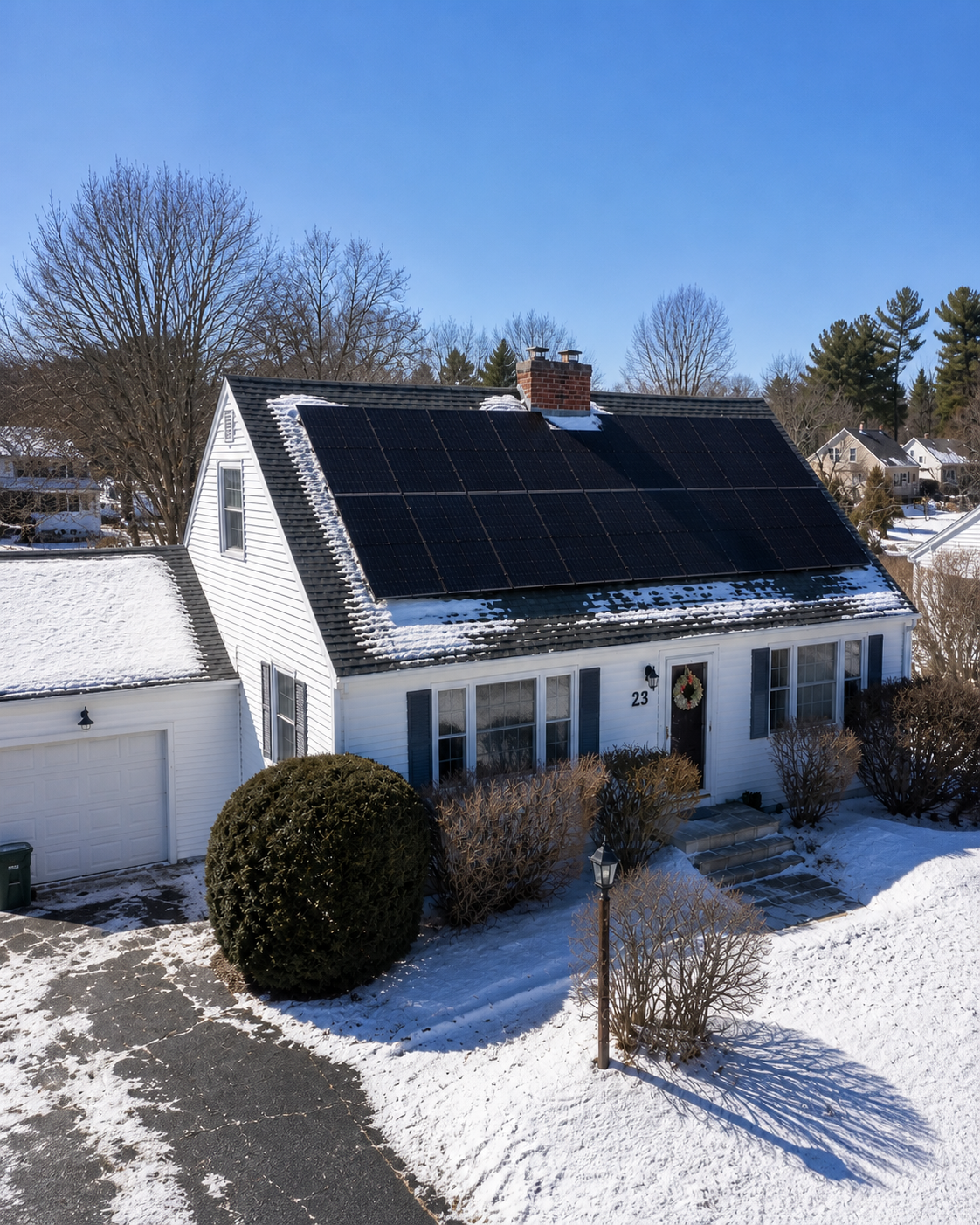
Almost always, yes. Standard NH roof framing is built for 50+ psf ground snow loads, and a properly designed solar racking system adds only 3–4 psf of dead load. Your installer will pull your structural calcs as part of permit review, if there's any concern, the racking layout gets adjusted. Snow itself slides off pitched panels within 24-48 hours, especially as the dark surface warms in sun.
How does NH's net-metering tier system actually work?
Residential systems up to 100 kW DC fall under the standard NEM 2.0 tariff, exported energy is credited at 100% of supply + 100% of transmission + 25% of distribution. On Eversource that's roughly $0.20/kWh in 2026 versus a $0.23/kWh retail buy rate. NH uses a monthly true-up, so excess credits roll forward month-to-month. The tier most homeowners need to know about is just one: residential under 100 kW, which is virtually every house.
Eversource, Liberty, or Unitil, does my utility change the project?
The financial structure is the same across all three (they all participate in NEM 2.0), but interconnection paperwork and queue times differ. Eversource typically processes residential interconnections in 2–4 weeks; Liberty and Unitil are usually similar. Your installer handles the paperwork either way. If you're unsure which utility you're on, the bill will tell you.
Do I need town approval, and is it a hassle?
You'll need a building permit from your town and an electrical permit, straightforward in nearly every NH municipality. Larger towns like Manchester, Nashua, and Concord have streamlined solar review processes. Smaller towns sometimes take a bit longer. Historic districts (think parts of Portsmouth or Hanover) may require extra review for street-visible installations. Your installer handles all of this.
Does the math change north of the notches vs. southern NH?
Some, but less than people expect. Northern NH (Coös, parts of Grafton) sees roughly 5–8% less annual solar production than the seacoast or Merrimack Valley due to more cloud cover and shorter winter days. But heating loads are higher up north, meaning a solar + heat pump pairing actually saves more, since you're displacing more oil and propane. We adjust the system size on your Score for your specific zip code.
Should I add a battery now or later?
If you want backup power during outages, common in the Lakes Region and during nor'easters, adding battery storage at install is more cost-effective than retrofitting later. batteries are now mostly a resilience play; the per-kWh case is harder without the 30%. (A lease/PPA structure still passes through the Section 48 ITC on storage paired with solar.) NH's NEM 2.0 already gets you most of the way on bill savings, so a battery is mostly about staying lit through outages. Your Score will weigh the trade-off for your specific home.
Other states and programs.
Looking for the same kind of program in another state, or a different program in yours? Tap any pill to jump.
See how solar fits your specific NH home.
Your Home Efficiency Score sizes the right system for your roof, models the production, and runs the rate-hedge math against your actual Eversource, Liberty, or Unitil bill, locked-in production cost, NEM 2.0 export credits, 25-year savings.
Get my report